Should a Patio Cover Include Integrated Gutters for Western WA Rain?
Integrated gutters can keep patio-cover runoff away from busy areas, but they work best when water has a suitable place to go. Here is what to consider for a Western Washington home.
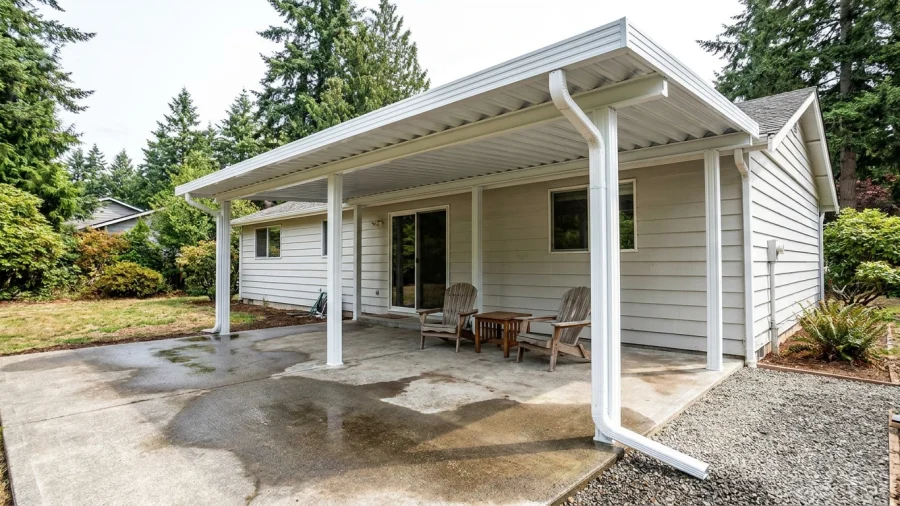
A patio cover can make an outdoor space more usable during Western Washington’s wet months. It also changes where rain lands. Before choosing a patio cover with integrated gutters, look at the entire path water will take—from the roof edge to a suitable discharge point.
Why gutter planning matters for a Western Washington patio cover
A cover sheds rain toward its edges. Without a planned runoff route, water may drip onto seating, splash across a walkway, or saturate a planting bed beside the house. Frequent rain makes those effects more noticeable, but the cover’s size, pitch, exposure, and the ground below matter as much as the regional climate.
Nearby trees can add debris, while wind can blow rain beneath even a well-drained cover. The useful question is not simply whether the cover has a gutter. It is whether a built-in gutter can collect runoff and carry it to a suitable place at this particular home.
What integrated gutters do—and what they do not do
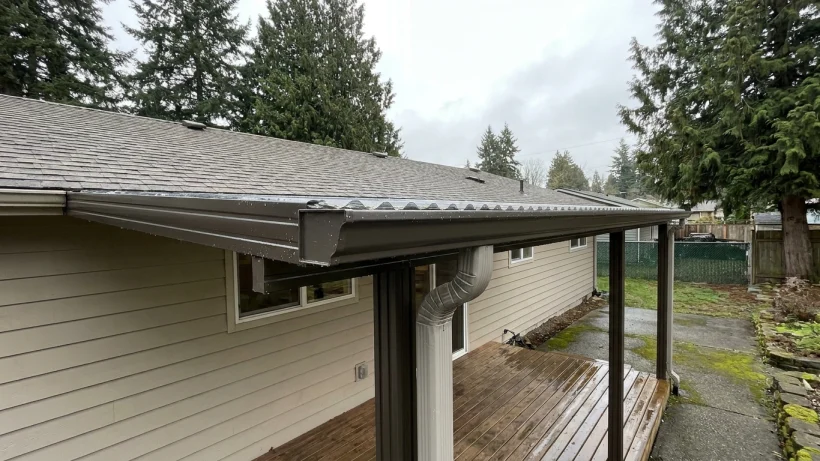
An integrated gutter is a collection channel incorporated into the patio cover’s edge or support design. Rain flows down the cover roof into the channel, then through an outlet and downspout. Depending on the system, this can give the roofline a cleaner appearance than a separate gutter attached afterward.
Integration does not eliminate the need for properly placed outlets, secure connections, and a clear discharge route. It also does not make the patio weatherproof or the drainage system maintenance-free. Leaves and needles can collect at outlets, and seams, connections, and downspouts need occasional inspection.
When integrated gutters are especially useful
Controlled runoff is particularly helpful when a patio door or regularly used walkway sits beneath the roof edge. Redirecting water may also reduce repeated dripping near furniture, a grill, or stored items, and limit splashback near siding or trim.
An integrated gutter may suit a homeowner who wants a finished-looking roofline and has a practical location for downspouts and discharge. These are reasons to consider the feature, not reasons to assume it will correct existing puddling or water near the foundation.
When a gutter may add complexity without solving the problem
A gutter collects water in one place. If there is nowhere suitable to send it, a downspout can concentrate runoff where it creates mud, erosion, or a slippery surface. Existing drainage problems need to be evaluated as site conditions rather than treated as something the patio cover will automatically fix.
Overhanging branches can increase cleaning needs. A narrow or low-slope cover, unusual roof geometry, or a larger roof area may also affect gutter and outlet planning; the installer should confirm what the proposed system can accommodate. If the main problem is rain blowing in from the sides, discuss side screens or other layout choices separately. Gutters manage roof runoff, not wind-driven rain.
Plan the full runoff path, not just the gutter
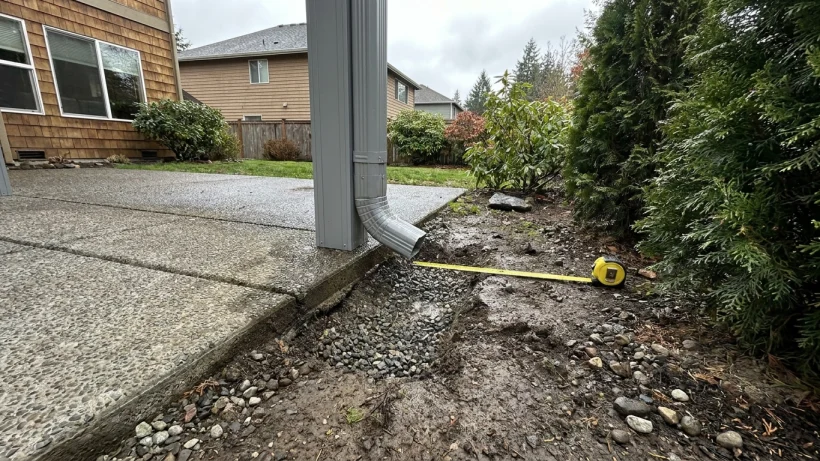
Start at the roof and trace where water will go. Ask how the gutter and outlets are sized for the proposed cover dimensions and roof configuration. Then locate each downspout on the plan. A downspout should not obstruct a door, window, step, or common walking route.
At ground level, check where each outlet discharges in relation to the house, patio, neighboring areas, and existing drainage features. The route should not direct water toward the foundation or repeatedly wet a spot where people walk. If the grade cannot carry water away effectively, separate drainage work may need to be considered and shown as its own part of the project scope.
Questions to ask before choosing an integrated gutter
- Is the gutter built into this specific patio-cover system, and how are its joints and outlets handled?
- How many outlets and downspouts are proposed, and where will each one sit?
- Where will the water discharge, and does the grading support that route?
- What inspection and cleaning does the manufacturer or installer recommend, especially if trees overhang the cover?
- What is likely to happen during unusually heavy rain or if an outlet becomes partly blocked?
- Does the estimate clearly identify the gutter, downspouts, and any separately proposed drainage work?
A practical way to decide for your home
Integrated gutters are worth considering when runoff would otherwise fall on a high-use area and there is a sensible way to carry it away. They may add less value if the discharge point is unresolved, the yard already has broader drainage issues, or wind-driven rain is the main concern.
Compare the gutter layout alongside the cover’s roof style, daylight, frame design, and intended use. The right choice depends on the actual roof dimensions, home layout, tree exposure, and ground conditions—not on Western Washington rainfall alone.