Open vs. Closed Roof Valleys: Which Works Best in Western WA Rain?
Compare open metal and closed shingle roof valleys to determine which design best handles heavy Pacific Northwest rainfall, pine needles, and moss growth.
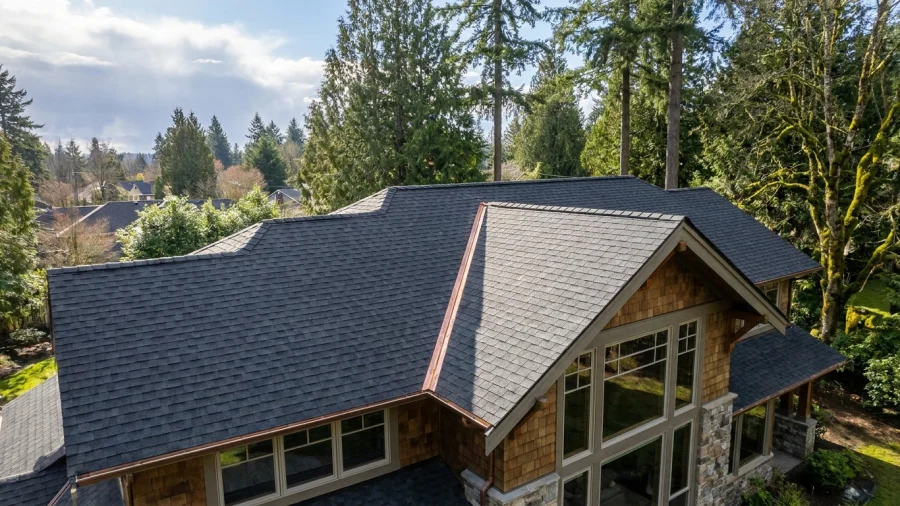
When planning a roof replacement in Western Washington, homeowners often spend significant time selecting the right shingle brand, architectural profile, or color palette. However, the details of how the roof planes intersect matter just as much for long-term durability. The roof valley is one of the most critical drainage intersections on any home, channeling enormous volumes of water during our typical fall and winter storms.
The choice between an open metal valley and a closed shingle valley directly influences how effectively your roof sheds water, handles falling tree debris, and resists moss growth over decades of damp weather.
The Crucial Role of Roof Valleys in the Pacific Northwest
A roof valley is formed where two sloping roof sections meet at an internal angle. Instead of water shedding downward evenly over a broad field of shingles, both planes direct their runoff inward toward this junction line. This creates a concentrated drainage channel that functions much like an open gutter directly on the roof deck.
Because of this geometry, valleys manage a massive volume multiplier. A single valley trough often carries dozens of times more water per square foot than the open planes to either side. In regions with modest weather, almost any standard valley detail can perform adequately. In Western Washington, valleys face constant challenges:
- Prolonged moisture exposure from weeks of steady rain and overcast days that prevent drying
- Sudden, wind-driven downpours that force water sideways under roofing edges
- Dense accumulations of wet organic debris, including Douglas fir needles, cedar fronds, and maple leaves
- Moss and algae colonization that thrives in slow-draining, shaded intersections
Understanding Open Roof Valleys: How They Work
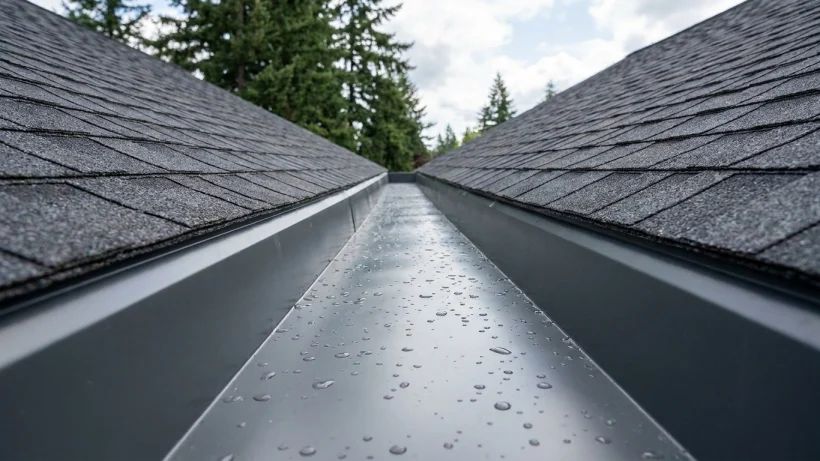
An open roof valley leaves an exposed metal trough running down the center of the valley fold. During installation, heavy-gauge sheet metal—typically painted galvanized steel, aluminum, or sometimes copper—is secured down the centerline over protective underlayment. The asphalt shingles on both sides are laid over the metal flanges and trimmed back straight, leaving an open channel roughly 3 to 6 inches wide.
Most professional open valley installations in the Pacific Northwest utilize "W-metal" or ribbed valley metal. This profile features a raised center ridge (crimp) down the middle that acts as a physical baffle. If heavy water rushes down one steep plane, the center rib prevents the runoff from splashing across the trough and surging beneath the shingles on the opposing side.
Because the exposed channel is smooth metal, water moves down the slope at high velocity without catching on shingle granule surfaces. From a design standpoint, open valleys create visible, clean contrasting or color-matched metal seams down the roof lines.
Understanding Closed Roof Valleys: Cut vs. Woven
A closed roof valley covers the valley intersection completely with asphalt shingles, hiding the underlying drainage fold from view. There are two historical methods for building closed valleys: woven and closed-cut.
Closed-Cut Valleys
The closed-cut method is the modern standard for closed valley installations. Shingles from the roof plane with the lower slope or smaller drainage area are installed across the valley centerline and extended at least 12 inches up onto the adjacent plane. Then, shingles from the steeper or larger plane are installed over the top and neatly trimmed along a straight chalk line roughly 2 inches off the valley center.
Woven Valleys
In a woven valley, shingles from each side are alternated back and forth across the centerline. While common decades ago with thin, flexible three-tab shingles, woven valleys are rarely used today. Modern laminated architectural shingles are too thick and rigid to bend across a valley crease without cracking or lifting at the corners, which creates leak points.
Head-to-Head: Open vs. Closed in Puget Sound Weather Conditions
Choosing the right system for a Puget Sound home means evaluating how each design holds up against local environmental factors.
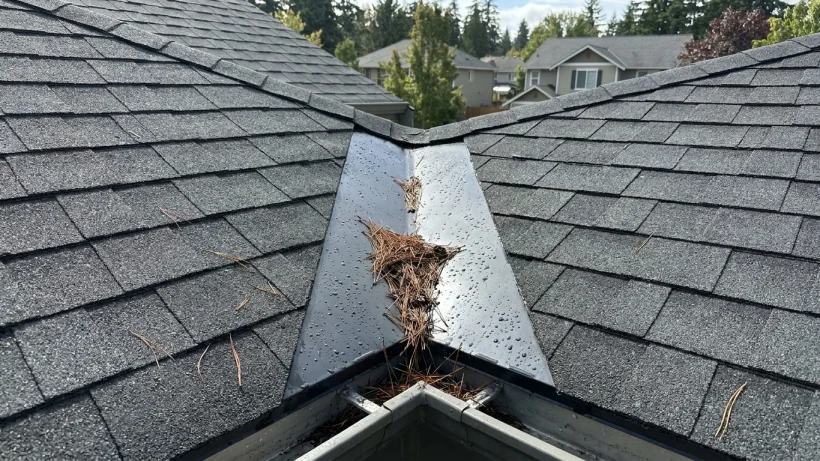
Evergreen tree debris is the most common cause of valley failure in Western Washington. Douglas fir, Western red cedar, and hemlock shed fine needles and debris year-round. In a closed-cut valley, needles catch on the cut shingle edges and rough mineral granules, creating a natural dam. In an open metal valley, the slick painted surface allows needles to slide freely down into the gutters.
Moss thrives in damp, shaded environments with trapped organic matter. Because closed valleys slow water down and trap needle mulch in the crease, they are frequent hot spots for thick moss growth that can lift shingle edges. Open metal valleys dry much faster and provide an inhospitable, non-porous surface that discourages moss rooting.
Water erosion is another factor over a 20- to 30-year roof lifespan. The abrasive, concentrated rush of gritty rainwater flowing through a closed shingle valley gradually strips the protective mineral granules off the shingle surface. Once granules wear away, the underlying asphalt deteriorates under UV light. Heavy-gauge metal in an open valley easily handles decades of high-volume water transit without surface erosion.
When an Open Valley Is the Clear Winner
For many homes across King, Pierce, and Snohomish counties, open metal valleys are the preferred installation method based on site-specific conditions:
- Properties with mature evergreen or deciduous trees hanging near or over the roofline
- Roofs with unequal intersecting slopes, such as an 8:12 main gable intersecting a lower 4:12 porch or dormer slope, where water from the steeper plane would overpower a shingle cut
- Long, continuous valley runs that collect runoff from large surface areas and direct heavy volume toward gutters
- Low-maintenance priorities where homeowners want rain to naturally flush debris from the roof between seasonal cleanings
When a Closed Valley Can Still Perform Well
Closed-cut valleys remain a viable and widely installed roofing detail under the right circumstances. They can perform reliably when specific roof and environmental conditions align:
- Homes located in newer subdivisions or open cleared lots with no overhanging tree canopy
- Roofs that receive direct, regular sunlight throughout the day to help damp sections dry thoroughly
- Shorter valley sections with moderate, matching roof pitches that carry low water volume
- Home designs where exposed metal lines would clash with the desired clean, monolithic exterior look
Crucial Valley Installation Rules Regardless of Style
Whether you choose an open metal or a closed-cut valley, the visible material is only the primary shedding layer. Long-term leak prevention depends entirely on the hidden flashing and proper fastener technique underneath.
First, every quality valley installation in Western Washington requires a full-width layer of self-adhering ice and water protector membrane centered down the valley fold directly onto the bare wood deck. Standard felt or synthetic underlayment alone is insufficient here; the rubberized membrane seals around any stray fasteners and provides a secondary waterproof barrier.
Fastener placement is equally critical. Installers must never drive nails into the valley center. Roofing nails must be kept at least 6 to 8 inches away from the centerline on both sides. Driving a fastener through the center water channel creates an immediate risk of leaks.
Finally, when trimming shingles in a closed-cut or open valley, each cut shingle must have its top outside corner clipped off at a 45-degree angle. This simple detail, known as "dubbing," directs descending water back down into the primary drainage path rather than allowing it to track sideways along the shingle edge.