Window Repair or Replacement: How to Decide in Puget Sound Homes
A draft, sticky sash, or foggy pane does not always mean a window needs replacing. Learn how to assess the problem, account for Puget Sound weather, and compare the scope of repair and replacement.

Deciding between window repair or replacement starts with finding out what has failed. A targeted fix may be enough for one worn component, while recurring leaks or deteriorated framing call for a closer look at the entire opening. In Puget Sound homes, that distinction matters because wind-driven rain can expose problems that are not obvious on a dry day.
Start with the problem, not the age of the window
Window age is useful context, but it is not a diagnosis. Glass, sash, frame, hardware, weatherstripping, sealant, and installation details can each cause trouble, and more than one issue may contribute to the same symptom. A window that sticks only when opened may need a different fix from one that lets in water during a storm.
Note when the problem appears and how widespread it is. Drafts during cold, windy weather, damp trim after wind-driven rain, and condensation during periods of high indoor humidity point to different questions. One difficult sash may be a localized issue; similar drafts at several windows may justify a broader assessment. Moisture on the room-side surface of glass is also different from fog or droplets trapped between panes.
Problems that may be repairable
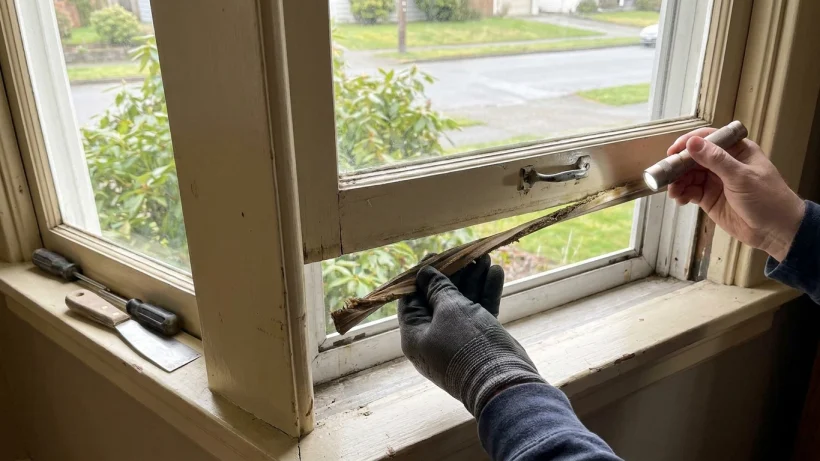
If the sash and frame are sound, a sticking or poorly latching window may need an adjustment or a replacement lock, balance, hinge, or other operating part. Worn weatherstripping or a localized gap may also have a targeted fix. First identify where air is moving; adding sealant without finding the source can miss the problem.
Minor exterior sealant deterioration may be repairable when the surrounding materials are dry and intact. A cracked pane or failed insulated-glass seal can sometimes be addressed by replacing the glass unit rather than the whole window, depending on the window design, available compatible parts, and sash condition. Paint, caulk, and expanding foam should not be used to conceal water damage or stand in for a failing installation.
Signs replacement may be the more practical option
Soft or crumbling sills, visibly deteriorated frames, and windows that no longer close or seal reliably can make a small repair less useful. Repeated water intrusion, staining, or peeling finishes around an opening also warrant investigation beyond the visible window parts. The source could involve the window, the surrounding wall, or both.
When several older units have failed glass seals, persistent drafts, or difficult operation, it may make sense to evaluate replacement as one project. That choice should reflect the overall condition and the homeowner’s goals, not an assumption that a new window will cure every issue. If flashing, drainage, siding, or the opening itself is letting in water, replacing the window without addressing that cause may leave the leak unresolved.
How Puget Sound weather changes the assessment
Western Washington’s long damp periods and wind-driven rain make moisture diagnosis especially important. After rainy, windy weather, look for damp trim, staining, or water at the sill, and record where and when it appears. One observation may not establish the source: water can travel before it becomes visible indoors.
A window opening manages water through several connected details, including the window, flashing, sealant, siding, and drainage path. Room-side condensation is a separate question; high indoor humidity, limited ventilation, and cold glass can all contribute to it. Recurring leaks or suspected concealed rot deserve a prompt on-site assessment rather than a surface-only patch.
Compare repair and replacement by scope, not just the first estimate

Compare what each option actually addresses. A repair might replace one glass unit or operating part, but leave an aging frame and opening unchanged. Consider the condition of those remaining components and how long the proposed fix is reasonably expected to remain useful. Also weigh how many windows are affected, how disruptive the work will be, and whether operation, comfort, appearance, or energy performance is a priority.
- Confirm whether the scope includes glass only, hardware, a sash, or the complete window and frame.
- Ask whether disposal, interior and exterior trim, and any needed opening repairs are included.
- For replacement, ask how the opening will be inspected and prepared, how water will be managed around it, and how both sides will be finished.
- Request written product details and a clear description of what the work does not address, especially when moisture damage is possible.
A clear written scope makes estimates easier to compare on equivalent work instead of a single headline figure. It also helps distinguish a limited repair from a project intended to address the full opening.
A homeowner checklist before deciding
- List the affected windows and identify drafts, difficult operation, glass damage, visible water, or surface condensation at each one.
- Photograph staining or damage and note when it appears, particularly after rain or during cold weather. Do not dismantle components or disturb suspected hazardous materials.
- Record changes over time and any previous repairs.
- Ask the evaluator to explain the likely source, the evidence behind the recommendation, and what the proposed work will and will not fix.
- Treat recurring leaks, soft framing, or suspected hidden moisture as reasons for an on-site assessment rather than a surface-only fix.
The most useful decision is the one matched to the condition of the window and its opening. A sound window with one failed part may be a good repair candidate; widespread deterioration or unresolved water entry calls for a broader plan.